Research
The GHZ Lab addresses fundamental problems in how molecules organize and transform in solution. We seek to understand how molecular structure, interactions, and solvent conditions determine the structures and assemblies that form, the transitions between them, and the time scales over which these processes occur.
Solving these problems requires a multidisciplinary approach spanning soft condensed matter physics, computational chemistry, chemical engineering, and quantitative biology. We combine statistical mechanics, molecular simulation, machine learning, and data science to develop predictive understanding that can guide the design of new materials, therapeutics, and diagnostics. Our overarching mission is to improve human health.
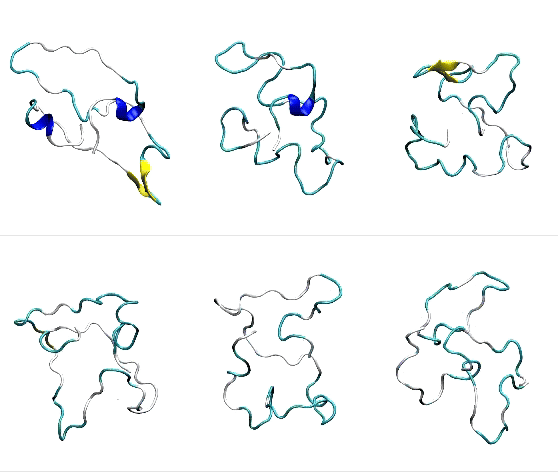
Intrinsically Disordered Proteins
Intrinsically disordered proteins and regions do not rely on a single stable three-dimensional structure. Instead, their sequences encode dynamic ensembles that respond to temperature, solvent conditions, post-translational modifications, and molecular partners. This structural flexibility allows disordered regions to participate in regulation and molecular recognition, but it also makes their behavior difficult to characterize and predict. We investigate how amino-acid sequence determines disordered conformational ensembles, how these ensembles support biological function, and how disordered regions influence neighboring folded domains. Many of the systems we study are regulatory proteins associated with cancer and other human diseases.
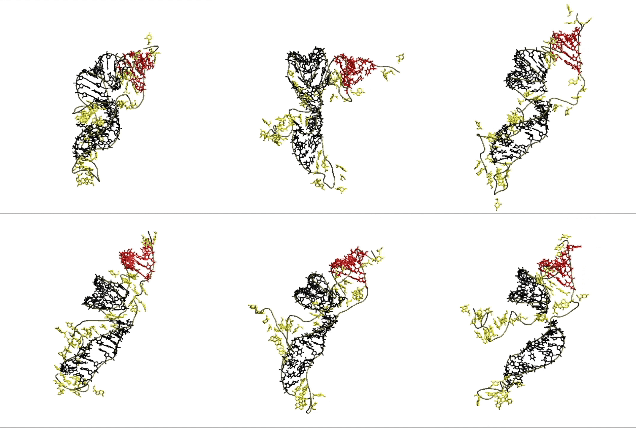
Multidomain Protein Design
Multidomain proteins are frequently understood by studying their constituent domains in isolation. However, a domain’s folding and stability may change when it is connected to other domains, embedded in a full-length protein, or influenced by terminal, linker, targeting, and anchoring regions. We investigate how molecular context reshapes the conformational landscapes of individual domains and the larger proteins containing them. Our goal is to establish physical principles for designing modular proteins whose domains fold, interact, and function predictably within a complete macromolecular architecture.

Biomolecular Condensates: Sequence, Partners, and Environment
Biomolecular condensates are often represented as simple droplets formed by a single macromolecule. Cellular condensates, however, contain many interacting components, and their composition and behavior depend on protein sequence, molecular partners, crowders, salt, and the surrounding solution. We study how these factors control molecular association, preferential partitioning, internal organization, and phase behavior. A major focus is understanding transcriptional proteins whose disordered regions and interaction partners are closely connected to gene regulation and cancer.
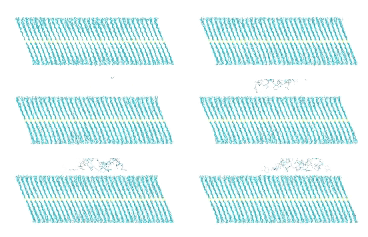
Solvent-Controlled Clustering and Crystallization
One focus area in our lab is the study of phase separation phenomena and biocondensates, which are crucial for understanding cellular organization and are implicated in various diseases. Our research aims to uncover the dynamics of
biocondensate formation, stabilization, and dissolution, along with their phase behavior and properties. The GHZ lab seeks to fill this gap and provide insights into the molecular mechanisms governing biocondensate behavior and their role in diseases. Moreover, we aim to unveil the mechanics and phase behavior of organic component crystallization and nucleation phenomena for the design of drug formulations and stabilization methods.
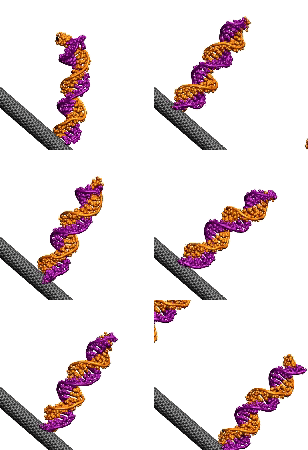
Computing Rare Events and Long-Time Dynamics
Many important molecular transformations occur too rarely or too slowly to be observed directly in conventional simulations. Folding, binding, nucleation, and phase evolution can span time and length scales far beyond those accessible to a single molecular trajectory. We develop, adapt, and combine enhanced sampling, machine learning, Monte Carlo methods, kinetic reconstruction, and continuum theory to overcome these limitations. Our objective is not only to calculate equilibrium free energies, but also to describe pathways, rates, and the long-time evolution of molecular systems.